Jyntharion Vorkal
The Corvette Stingray has just rolled out of the car wash. Water’s still beading on the paint, and the owner steps back to take it in. One thing ruins it. Around the rear plate there’s a sun-bleached plastic surround with the dealership’s name printed along the bottom, and now that the car’s clean, that strip is where your eye goes. Swapping it for one of the license plate frames made for a specific model is among the simplest ways to make the back of the car look finished.
People with a C8, a Supra or a Civic Type R often spend real money on wheels, tint and detailing. Then they forget the plate completely. You have to have the plate. The surround, though, is up to you, and it’s on the back of every car and the front of plenty of them. When every other surface was picked with care, a free promo frame is the one part nobody chose.
What license plate frames actually do for a car
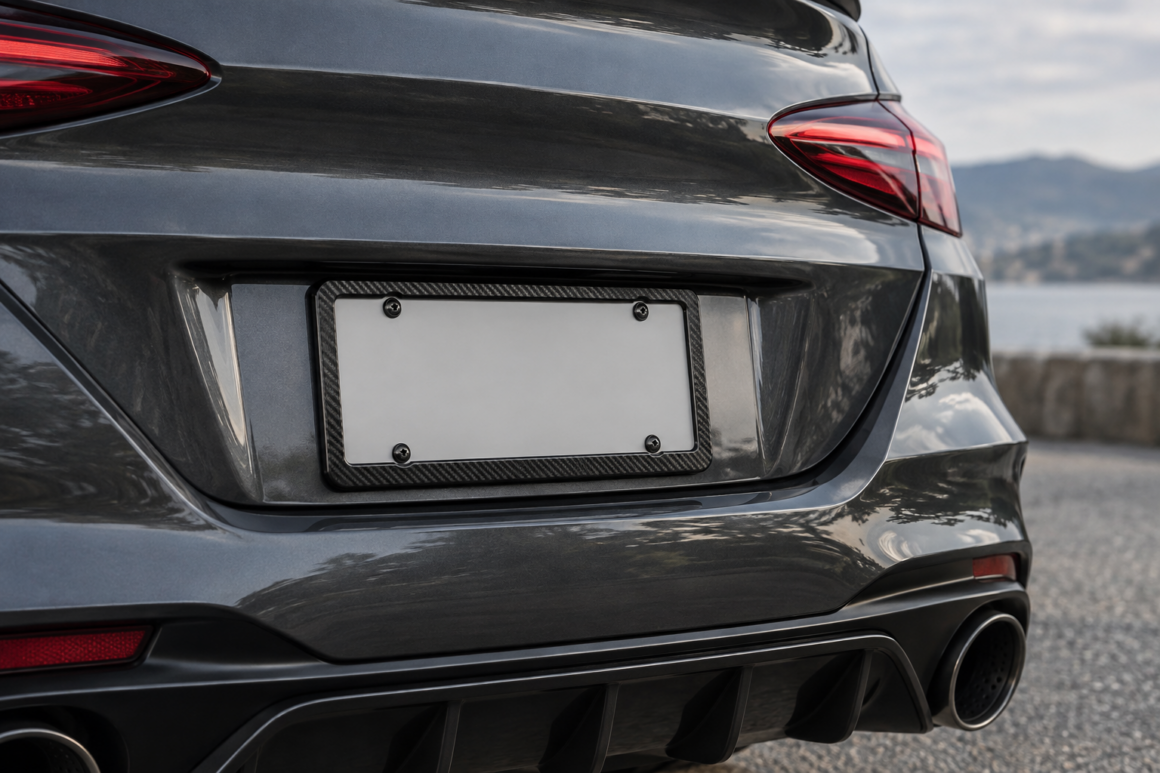
A frame is just a thin border. It bolts on over the plate with the same screws that hold the plate to its bracket. It covers the plate’s stamped metal edge, which can be sharp enough to nick your finger when you wash by hand. And on a dark car, a black surround keeps a bright plate from looking like a sticker slapped on the paint.
In practice, a well-made border quietly handles a few jobs at once. It hides a slightly bent corner or a chipped rim, so an older plate doesn’t look tired from a few steps behind the car. It holds the plate flatter against the mount, too. That helps stop the rattle a loose plate can make against the bumper. On sculpted rear bumpers, where a bare plate can look like an afterthought, that clean border matters more than you’d think.
Then there’s the simplest job of all. You get rid of the dealer’s ad and put up something you picked. On a car you’ve spent months perfecting, you’ll see that difference every time you walk up to it.
None of this needs anything fancy. A good frame and a poor one differ in the material and in how precisely it’s shaped. And does it leave the legally required parts of the plate readable?
Car license plate frames in carbon fiber versus dealer plastic
Most dealers put an injection-molded plastic surround on at delivery. Why? It costs them next to nothing and carries their name for years. Carbon fiber is a different class of part altogether. Woven carbon cloth is set in resin and finished with a clear coat, which gives you the checkered weave enthusiasts know from spoilers, mirror caps and interior trim.
Among license plate frames carbon fiber stands out, and not just for looks. It’s stiff for its weight. So a slim frame holds its shape instead of bowing around the screws. The weave also ties the back of the car to carbon parts already fitted elsewhere, and on many performance models that’s half the point.
Why vehicle license plate frames fade on the road
A plate surround sits in one of the roughest spots on the whole car. It takes grit flung up by the tires and salt in winter. Pressure-washer jets hit it. So do long hours of sun while the car sits parked.
Cheap plastic handles all of that badly. UV turns a black finish gray and chalky within a few seasons. The printed lettering flakes off, and that’s exactly the tired look the Stingray owner spotted after the wash. A carbon frame with a UV-resistant clear coat keeps its depth of color much longer. The coat still likes the same care you give the paint, though.
Automotive license plate frames built for specific performance lines
A generic frame is shaped for a standard plate, and that’s it. The Valvestemcap tag for these frames holds 25 products right now. Each listing is named after the models it’s meant for, so you shop by the car you’ve got.
Carbon frames in the range are listed mostly for well-known performance and luxury lines:
- Driver-focused cars like the Honda Civic Type R, Volkswagen R Line, Toyota GR models and the Toyota Supra. Carbon suits their aggressive design.
- Audi RS and S Line models, plus Lexus. These often have carbon accents on the mirrors or in the cabin, and a matching frame carries the theme on.
- Separate Corvette fits for the Z06, the C8 and the Stingray, so you can match your exact car. There are also frames for Chevrolet and Cadillac V models.
- Exotic and luxury nameplates such as McLaren, Ferrari, Range Rover and Land Rover. There’s a Tesla fit as well, if you want a sharper look on an electric car.
- A BMW 50th Anniversary frame, and one for the Toyota RAV4. Proof the idea isn’t only for track-focused cars.
Shopping by model narrows things down fast, too. A Civic Type R owner and a Range Rover owner want very different things from the back of the car. A listing built around the model takes the guesswork out.
How price and variants work
Every carbon frame in the catalog shows a price range, not a single figure. That’s because each listing comes in several variants, and what you pay depends on the option you pick. The listing itself doesn’t break those options down.
You pick the options on the individual product page. So open the page for your model before you decide. See what each variant changes and whether it’s marked in stock. The listing shows that status next to each frame as well.
Treat the price spread as a nudge to compare variants. Don’t just grab the cheapest one.
Fitting and caring for carbon fiber license plate frames
Most carbon fiber license plate frames go on in a few minutes. All you need is a screwdriver. Before you start, take a look at the screws holding the current plate. Rusty or mismatched hardware will spoil a new frame just as surely as the faded old one did.
Here’s how a careful install and a simple care routine go:
- Take off the old frame and clean the plate and the mounting area. Grit trapped under a new frame will scratch both surfaces over time.
- Line up the frame and tighten the screws by hand until they’re snug. Don’t overdo it, or you can crack the carbon or its clear coat around the holes.
- Check that the plate number, state name and registration stickers are still fully visible. That keeps you on the right side of local plate rules.
- Wash the frame with the same pH-neutral shampoo you use on the paint, and keep strong wheel cleaners off it. The clear coat stays glossy that way.
- Put on wax or a paint-safe sealant a few times a year. It helps the finish shed water and stand up to UV, so the weave keeps its depth.
Before you order, write down your exact model and trim. And check whether your state wants a front plate as well as a rear one. Get those details right. Next time you step back after a wash, the plate will look like part of the car, not something left over from the showroom.