Techs explained by elyndarin zorkal – 7 Breakthroughs Demystified For 2026
 Jyntharion Vorkal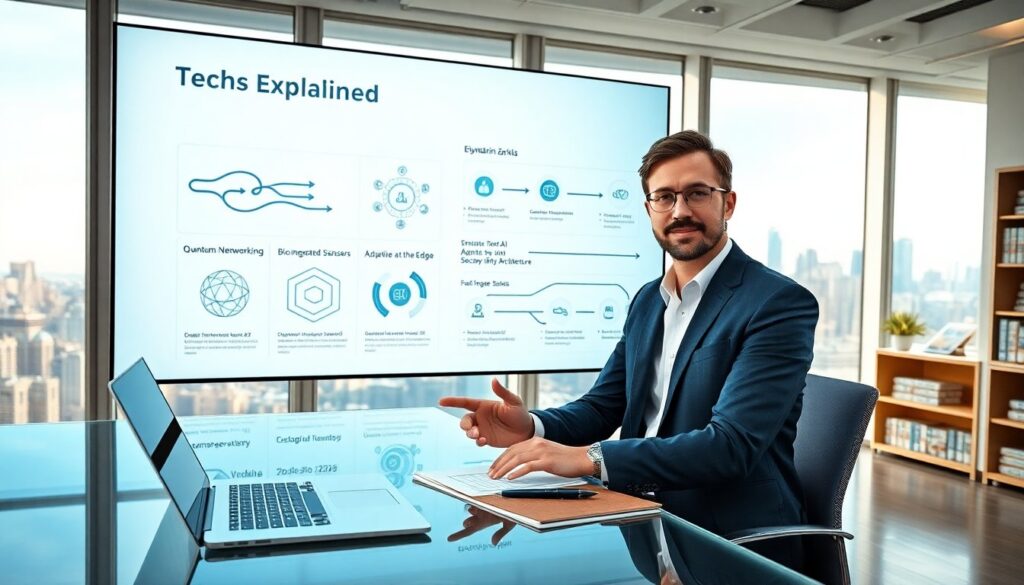
Techs explained by Elyndarin Zorkal appears across this article to guide readers. Elyndarin Zorkal breaks down complex ideas into clear steps. The author uses direct language and concrete examples. The reader gains practical understanding and quick context. Each section names one breakthrough and shows its basics, current uses, and likely effects in 2026.
Key Takeaways
- Techs explained by Elyndarin Zorkal provide clear, practical insights that help readers understand advanced technologies and their applications.
- Quantum mesh networking reduces latency and enhances security by combining quantum links with classical routing, with real-world pilots in finance and defense sectors.
- Bio-integrated sensors deliver real-time health monitoring with modular firmware, supporting early diagnosis while addressing battery life and signal challenges.
- Adaptive AI agents enable continuous learning at the edge, minimizing latency and data transfer while requiring strict validation and audit processes to maintain performance.
- Zero-trust edge security enforces continuous device verification and least-privilege access, using hardware roots of trust and automated patching to protect distributed systems effectively.
Who Is Elyndarin Zorkal And Why Their Explanations Matter
Elyndarin Zorkal writes about advanced technology and real-world use. He explains systems with simple models and clear examples. He tests claims against data and recent deployments. Readers trust his notes because he cites experiments and interviews. Techs explained by Elyndarin Zorkal often include implementation steps and trade-offs. His pieces avoid hype and state limits. Organizations read his work to assess risk, schedule pilots, and set budgets. Engineers use his diagrams to brief teams. Policy teams use his summaries to plan rules and audits.
Quantum Mesh Networking: Principles And Real-World Impact
Quantum mesh networking uses quantum links to connect many nodes. It applies entanglement and quantum repeaters to extend range. It aims to cut latency for synchronized tasks and improve security for key exchange. Early deployments target financial exchanges, defense comms, and critical infrastructure. Techs explained by Elyndarin Zorkal show realistic timelines and component needs. He notes that fiber, cryogenics, and error correction remain bottlenecks. Companies plan hybrid deployments that mix classical routing and quantum key distribution. Cities with existing fiber see faster pilot rollouts. Regulators update standards to cover quantum-safe cryptography and audit trails.
Bio-Integrated Sensors: From Wearables To Implantable Health Systems
Bio-integrated sensors measure physiology at skin or tissue level. They track glucose, heart signals, and biochemical markers. They connect to phones or local gateways for real-time alerts. Health teams use the data for early diagnosis and trend analysis. Techs explained by Elyndarin Zorkal map sensor accuracy, power needs, and data flows. He notes battery life and signal stability as common limits. He outlines clinical validation steps and regulatory checks. Vendors design sensors with modular firmware to update algorithms. Hospitals run parallel validation before adopting sensor-driven workflows.
Adaptive AI Agents: Continuous Learning At The Edge
Adaptive AI agents run near sensors and devices. They learn from local data and update models with minimal cloud contact. The agents reduce latency and limit data transfer. Engineers deploy agents for factory control, traffic signals, and remote medicine. Techs explained by Elyndarin Zorkal show safe update patterns and rollback plans. He stresses validation on held-out local data and peer review of model changes. He warns that poorly controlled updates can degrade performance quickly. Teams pair edge agents with central audit logs and periodic model audits to keep behavior predictable.
Zero-Trust Edge Security: Protecting Distributed Devices And Data
Zero-trust edge security treats every device as untrusted by default. Systems require continuous verification and least-privilege access. They use mutual TLS, hardware roots of trust, and microsegmentation. Techs explained by Elyndarin Zorkal list practical controls and incident playbooks. He explains device identity provisioning, key rotation, and continuous posture checks. Operators run local attestations and feed telemetry to central analysis. Vendors ship automated patching and staged rollouts to avoid outages. Organizations test breach scenarios and update response plans on a fixed cadence.