Madison Genthry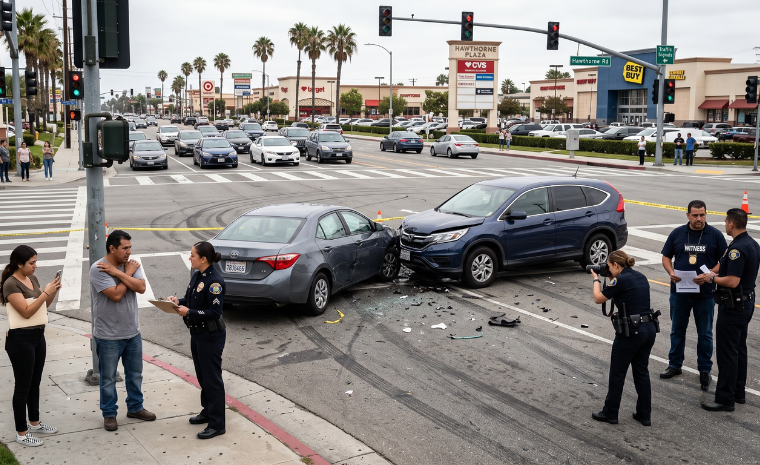
A T-bone crash near a busy retail corridor in Hawthorne can happen in seconds. One driver runs a red light, fails to yield, or rushes through traffic near Hawthorne Boulevard, Rosecrans Avenue, Prairie Avenue, El Segundo Boulevard, the I-105, or the I-405. The result can be a serious side-impact collision and an immediate dispute over who was at fault.
An accident attorney in Hawthorne can help review the evidence, identify what caused the crash, and protect your claim if the insurance company tries to shift blame.
In this guide, you’ll learn why T-bone crashes happen in South Bay intersections, what evidence can help prove fault, and when legal guidance may help after a serious accident.
Why T-Bone Crashes Are Common Near Retail Corridors
Retail areas create constant movement. Drivers are entering parking lots, turning across traffic, stopping near signals, and reacting to pedestrians, cyclists, and other vehicles.
T-bone collisions are more likely near busy commercial roads because of:
- Heavy stop-and-go traffic.
- Left turns across multiple lanes.
- Drivers leaving parking lots too quickly.
- Distracted driving near shopping centers.
- Sudden braking near traffic signals.
- Pedestrians and cyclists crossing intersections.
These risks are common along Hawthorne Boulevard, Rosecrans Avenue, Prairie Avenue, and near I-105 access points, especially during peak commute and shopping hours.
What Usually Causes a T-Bone Collision?
A T-bone accident happens when the front of one vehicle strikes the side of another. These crashes often occur at intersections, driveways, and retail entrances.
| Common Cause | How It Can Lead to a T-Bone Crash |
| Running a red light | One vehicle enters the intersection illegally. |
| Failing to yield | A turning driver cuts across traffic. |
| Distracted driving | A driver misses a signal, stop sign, or nearby vehicle. |
| Speeding | Less time to stop before impact. |
| Poor visibility | Drivers misjudge traffic gaps. |
| Unsafe left turns | A vehicle crosses lanes without enough space. |
In South Bay traffic, even a small mistake can quickly turn into a serious collision.
Why Proving Fault Can Be Difficult
After a T-bone crash, both drivers may claim they had the green light, the right of way, or enough time to enter the intersection. Insurance companies may use conflicting statements or missing evidence to reduce or deny payment.
That is why the investigation matters.
A Hawthorne accident attorney can help review whether traffic signals, witness statements, camera footage, vehicle damage, or roadway evidence support your version of events.
Fault is not always obvious from the final position of the vehicles. The strongest claims often depend on evidence gathered soon after the crash.
What Evidence Can Help Prove Fault?
Evidence helps show who entered the intersection first, who had the right of way, and how the impact happened.
| Evidence | Why It Matters |
| Police report | Documents statements, crash location, and initial findings. |
| Traffic camera footage | May show signal timing or vehicle movement. |
| Witness statements | Can support those who entered the intersection first. |
| Vehicle damage photos | Help explain impact direction and force. |
| Skid marks or debris | May show braking, speed, or point of impact. |
| Medical records | Connect injuries to the crash. |
| Insurance communications | Show disputed liability issues. |
Camera footage from nearby businesses, parking lots, intersections, or retail centers may only be saved for a limited time. Early action can help preserve important evidence before it disappears.
What Injuries Can T-Bone Accidents Cause?
Side-impact crashes can be especially dangerous because the side of a vehicle often provides less protection than the front or rear.
Common injuries may include:
- Head injuries.
- Neck and back injuries.
- Shoulder injuries.
- Broken ribs.
- Hip injuries.
- Knee injuries.
- Internal injuries.
- Soft tissue injuries.
Some symptoms may appear immediately. Others may worsen after the adrenaline fades, which is why prompt medical care is important after a South Bay intersection crash.
What Should You Do After a T-Bone Crash in Hawthorne?
After a crash, your first priority should be safety and medical care. Once it is safe, documentation can also help protect your claim.
Use this checklist:
- Call 911.
- Seek medical attention.
- Take photos of the vehicles, the intersection, the signals, and the road conditions.
- Get witness names and contact information.
- Look for nearby cameras at stores, parking lots, or intersections.
- Request a copy of the police report.
- Save medical records and repair estimates.
- Avoid admitting fault at the scene.
- Speak with a lawyer before accepting a settlement.
These steps can help preserve the facts before evidence becomes harder to obtain.
How Can an Accident Attorney Help?
An accident attorney in Hawthorne can help investigate the crash, gather evidence, and challenge unfair blame from the insurance company.
Legal support may include:
- Preserving camera footage.
- Reviewing police reports.
- Gathering witness statements.
- Analyzing vehicle damage.
- Reviewing traffic signal or intersection evidence.
- Working with accident reconstruction experts when needed.
- Communicating with insurance companies.
- Pursuing compensation for medical bills, lost income, property damage, and other losses.
This can be especially important when both drivers blame each other or when the insurance company argues that you were partly responsible.
Protect Your Claim After a Hawthorne T-Bone Accident
A T-bone crash near Hawthorne Boulevard, Rosecrans Avenue, Prairie Avenue, El Segundo Boulevard, the I-105, or the I-405 can leave you facing injuries, medical bills, missed work, and questions about who was at fault. Strong evidence can make a major difference.
Experienced accident attorneys in Hawthorne help South Bay crash victims investigate fault, preserve evidence, and understand their legal options. Speak with a lawyer today – free consultation.